
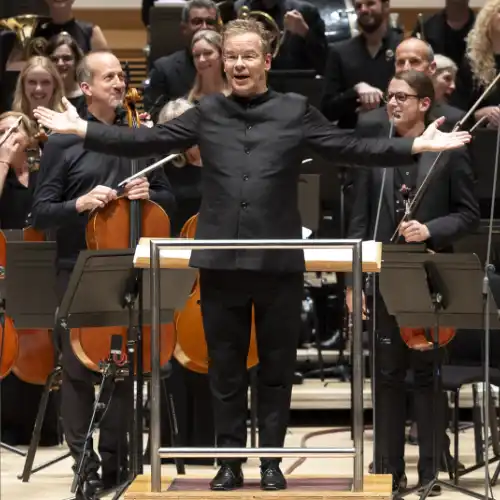
One of the things that radio producers are said to be most frightened by is silence. The recently announced Chief Conductor-designate of the BBC Scottish Symphony Orchestra Antony Hermus began this performance, broadcast live on BBC Radio 3, by testing that fear and indicating from the very beginning that he was very much the master of the whole hall. The welcoming applause faded. He took his place on the rostrum. He waited, just long enough to test any twitchy producer. That silence – nearly half a minute – was far from empty. He surveyed his new orchestra. And then drew his hands together very slowly and bowed his head in an obvious gesture of reverence, calling the audience to prepare for something both profound and spiritual.
First on the programme was a recent work, Mors Aeterna, by Dutch composer Willem Jeths. Composed in 2015, this served as a preliminary study for his Requiem that was completed a few years later. It isn’t difficult to see why this might form a prelude to Mahler’s Tenth which followed without a break between the two. Both pieces are haunted by death and there are stylistic similarities – crashing percussion beats, and a haunting flute solo leading to ultimate consummation in the strings.
Of particular note were the two crashing beats from the percussion in the piece by Jeths. Fittingly, these are scored for a Mahler hammer, familiar from the Sixth Symphony; held aloft and brought down with a terrifying thud on a wooden plinth. Death had arrived with a crash. One hears of audiences being made to jump out of their seats in concerts. One rarely sees it. These two crashes separated the moody reflections of the brass section which open the piece from the long slow strings that take us into eternity – or if not eternity, on this occasion directly into the Mahler.
I understand from the pre-concert talk that Antony Hermus had tried replacing the Mahler hammer with a sonorous bass drum in rehearsal, presumably to make obvious the connection with the funereal beats of such a drum in the Mahler symphony that we were heading into. In the end, this decision was reversed when Jeths (who was also present in the hall) heard the rehearsal. It was the correct decision. Mahler was leading us to his own funeral; Jeths was cracking open doom itself.
The transition into the Mahler, here played in the performing version completed by Deryck Cooke, was flawless and direct. No stopping for prayer here. The luxurious entrance of the viola section was perfectly judged, as was the pace of the lush string playing right through to the famous dissonant chord near the end. The build-up to it was measured and stately with plenty of time to breathe. When it came, it pulsated through the hall.
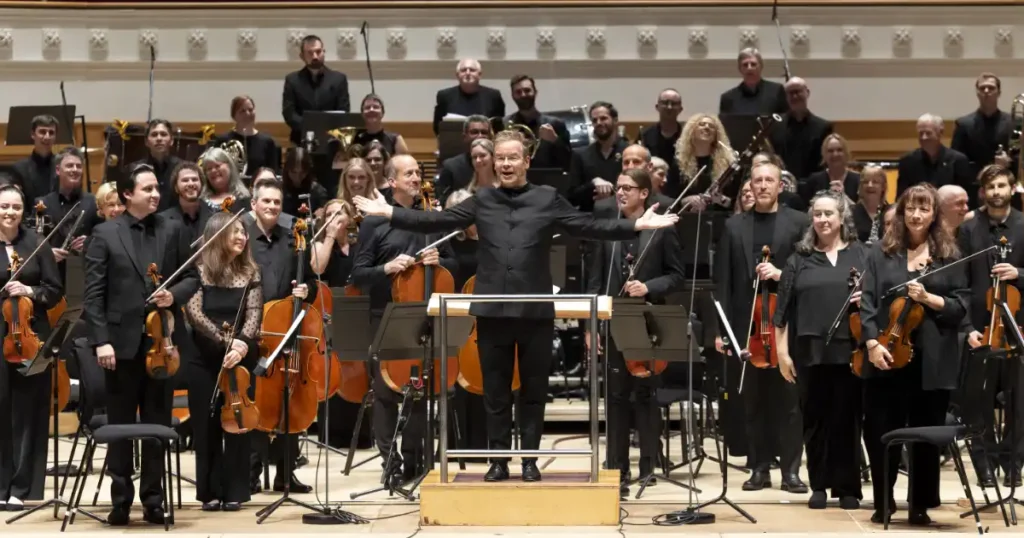
The real moment of dissonance, though, came at the end of this movement. Some members of the audience, perhaps confused by the two pieces running together, started a flurry of applause. However, Hermus was having none of it. Dressed entirely in black, his arms were thrown slightly behind him and were still moving, folding themselves back towards his body like the wings of a swan. As the applause started, the wings very gently flapped, hushing the noise with both determination and good humour.
Mahler’s Tenth Symphony creates a space for reflection on mortality and regret. Mahler sketched the whole symphony but had fully orchestrated only the first movement when he died at the age of 51, a death surely prefigured in the music. He had recently discovered the divided affections of his wife Alma, and there is a thread of betrayal running through the music too. Yet hope never seems entirely lost and, notwithstanding the inebriating dances with the devil along the way, it refuses to die. The two scherzo movements were crisp and coherent. From the second of them, everything seemed to lead towards the beautiful flute solo in the fifth and final movement. Here it was allowed to sing. Beauty will survive us all, it seemed to say. Therein lies our consolation.
That shattering nine-note chord returns in the finale, but the purity of the clarion call of a high A on the trumpet surely indicated that despair should not have the final word.
At the end of the last movement there was an all too brief silent pause before one overeager member of the audience started to applaud. The black swan on the rostrum, however, wasn’t finished. With his arms still aloft, Hermus made clear what was intended and desired: peace at the last. The sole intruder into that silence gave in to the weight of the tranquillity in the hall.
Wandering deep into the orchestra to urge the soloists and sections to stand, he found that his third return to the stage was dominated by the orchestra’s own applause for him.
There is a theatricality to Hermus’s conducting that perhaps owes a debt to his years as a conductor of opera. The prayer-like pause at the beginning seemed also to suggest the enduring influence of his father, a conductor of church music.
Clearly, we have a Chief Conductor-designate who is taking charge not only of the orchestra, but of the audience in the room too.
Press ticket provided by BBC SSO. Images: Martin Shields/BBC