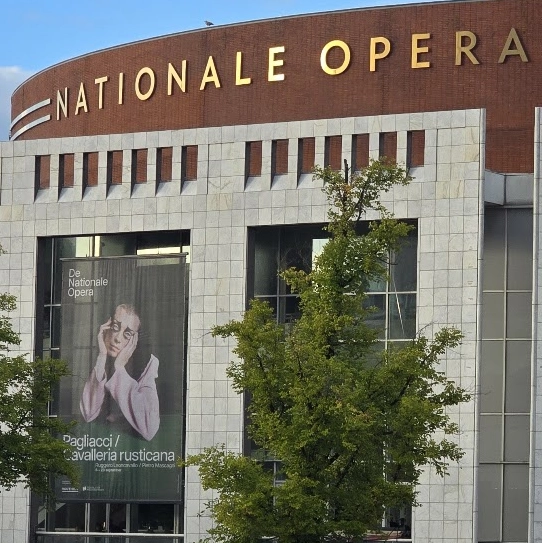
Dutch National Opera opens its season with a revival of Robert Carsen’s acclaimed production which reverses the order of the familiar Cav and Pag pairing and reverses every expectation the audience might have about them along the way.
These two classics of Italian verismo made the original case for opera being about ordinary people instead of gods, warriors and royalty. So when an audience gather for a night at the opera, where better to set these pieces than in an opera house – perhaps this opera house. The original conceit was that those being played on stage were just like those who came to see a show. Here that is taken to extremes. The company and the audience merge. We are on stage. They are in the stalls.
Even before the house opened, a deathly drum beat could be heard echoing around the foyer. We were being called to witness something that was never going to be comfortable.
Pagliacci was being produced in an opera house and the unravelling of any boundaries between audience and performers was both the topic and the tool for our entertainment.
A stunning coup de theatre takes place very early on as the crowd gather on stage. It would be unfair to future audiences to reveal exactly what happens though anyone on their phone watching a flashmob video might start to wonder who is watching whom.
The reversals of public and private are a constant theme. Sometimes we see front of house and sometimes the stage is reversed. Drama on stage is as nothing to the drama offstage, as our protagonist Canio (Riccardo Massi) lives the reality of playing a clown whilst discovering the infidelity of his wife. His Vesti la giubbia, performed as he puts on his makeup in front of a red curtain draws the audience into his passion yet he still knows it is his job to make them, no, to make us, laugh in the end.
Canio’s unfaithful wife Nedda (Corinne Winters), was every inch the destructive seductress. The clarity of her upper range was used to devastating effect to declare that she was not settling for anything other than her heart’s desire.
It ends badly of course. Death comes to us all. And none of us were surprised when it came to the lovers. Their passion was just as doomed as the stories of infidelity taking place amongst any number of the gods and heroes of the past.
After the interval, we returned to find the cast frozen in time in the same pose that we had left them at the end of the first half. Unfreezing the scene, we realised that we were being taken backstage again. The actors from the first production made their way to a vast dressing room illuminated by vanity dressers to remove their makeup and put on their street clothes.
That their street clothes were identical to the clothes that they had been wearing on stage was a repeating theme that again questioned the boundaries between the normal and the theatrical, undoing the distinction between them and us.
Setting Cavalleria Rusticana in the dressing rooms and rehearsal spaces of an opera house, the opera house we found ourselves in was a bold departure from a dusty Sicilian village. It certainly made one think a lot but the drama of the Easter hymn was more than a little lost as it became simply an opera chorus rehearsing their next production whilst Raehann Bryce-Davis as Santuzza simply became a scorned member of the company, isolated by bickering and gossip. Her voice had all the raw emotional power that a Santuzza needs but was the passion of a scorned opera chorus member to be compared with that of a betrayed Sicilian woman on Easter Day in the searing light of the sun?
Director Robert Carsen’s answer to this question is a resounding yes. We cannot let the conventions of verismo productions of the past negate the central assertion of verismo in the first place. Agony, love, retribution and desire are all universal. They are ours, not theirs.
Notwithstanding the risk of disappearing up its own meta-theatre in the second half, this was an emotionally rich journey. We learned something about theatre. We learned something about opera. We learned something about ourselves.