A single spotlight falls on a pianist. He begins to play. Classical Glass – moody, repetitive arpeggios.
The audience settled – some sitting in the balcony, some standing about or reclining against a wall and some sitting on the yoga mats they had been encouraged to bring along.
And as the piano continued to play, from amidst the encircling gloom, the players of the RSNO slowly came and took their places. It was as though the disappearing ghosts of the first players of Haydn’s Farewell Symphony had decided to make amends.
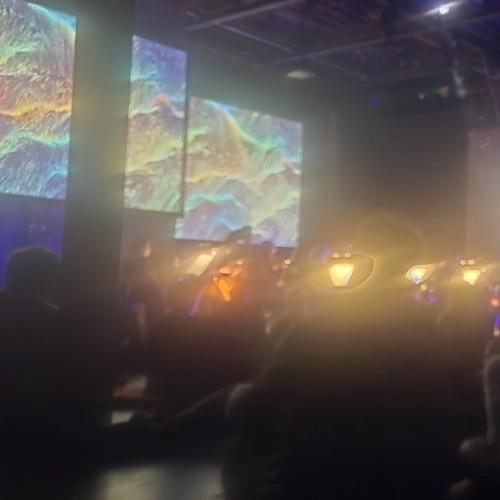
Once they were all in place, the piano stopped, the pianist (Patrick Hahn) took a bow and made his way to the podium, turned around and began to conduct the main pieces of the evening, lit now by geometric shapes made by spotlights shining through a hazy mist. This was a production that was never simply about the music.
Kicking things off were the familiar pulsating moods of Philip Glass’s Prelude for Akhnaten. (Fittingly, the piano had been playing a prelude to the Prelude).
Glass’s sound is familiar to many now. There is no longer a sense of surprise to it. But what is it? Bearing a clear debt to minimalism, there is still a lot going on. The rhythms urge things on. As the brain relaxes into the repetitions, more and more is added to what becomes a sophisticated complex space.
The inside of the Tramway provided the perfect metaphor for the music. The bricks of the building are relentlessly the same in all the walls and yet the more you look at them, they are relentlessly different. Together they sustain a vast and cavernous space. So with the bars of Glass’s music.
And so on to the main event of the evening, the Bowie Symphony. It is hard to know what any diehard David Bowie fans might have made of it. As I overheard someone say, you can’t exactly sing along to it.
Perhaps the music of David Bowie works here like the tune of the tavern song L’homme armé (The Armed Man) giving inspiration to so many polyphonic masses of the Renaissance; the themes of Bowie’s songs being mere seeds that would grow and flourish anew in Glass’s maximinimalist world.
With the exception of one or two scruffy horn entries, the RSNO was on good form but everyone involved must have been very aware that this was a more than just a concert for the ears. Above the orchestra, filling the space were three large screens, onto which were projected Tatsuru Arai’s swirling, birling graphics. These too were seeded by familiar things – flowers here, building there but then as the brain tried to make out meaningful shapes they metamorphosed into patterns that had form but no apparent meaning.
Perfectly matching the music, the graphics seemed to emphasise that this was not an experience designed to help us understand something or to pin down a thought or experience. Much more, this was about letting go and letting all things be. It was a space designed more for contemplative presence than comprehension.
This is the music of paradox. Minimalist in conception. Maximalist in expression. Relentlessly calm. Peacefully thrusting us forward through life. Busy. And utterly still.