
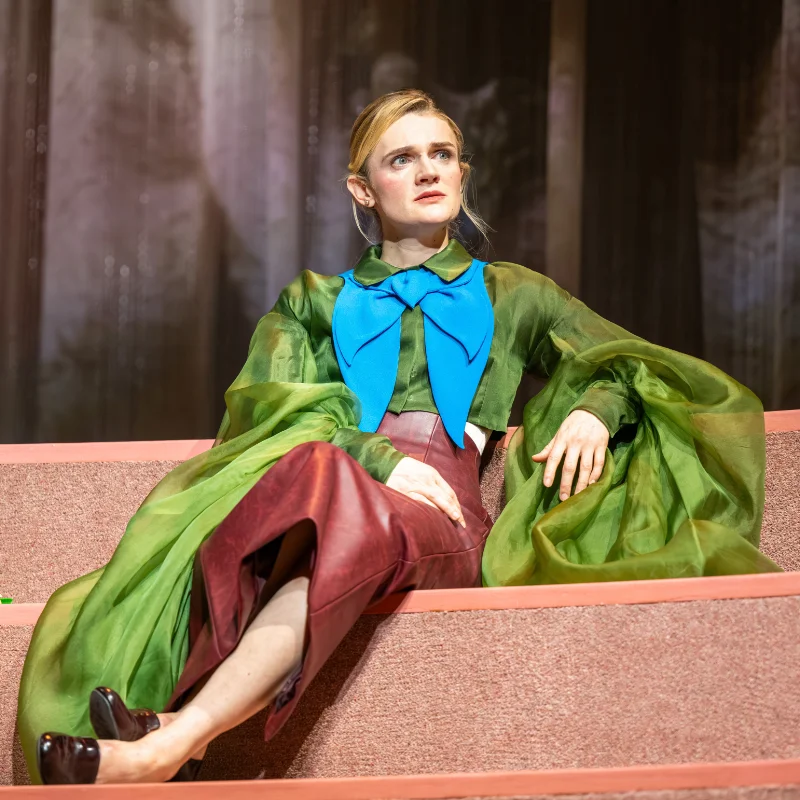
Jean Brodie is a monster. At least, she used to be.
Miss Jean Brodie holds a curious, enduring place in the Scottish psyche. She is loved, typifying a genteel Edinburgh sensibility from long ago. We remember her devotion to her girls, and a complex personality both charismatic and inspirational. She may be manipulative, but the various ways she has been portrayed have given her a respectability she might herself have scorned. Scotland became fond of Muriel Spark’s creation, which is odd, because Miss Jean Brodie is, and always was, a fascist.
This National Theatre of Scotland production of David Harrower’s play, based on the novel, presents Miss Brodie more as the product of her time than anything else. We are reminded that many admired Mussolini and the Blackshirts in the period before the Second World War.
Spark’s original, however, isn’t about how a witty teacher stood out from a population prepared to give the far right the benefit of the doubt. It is about a teacher betrayed by one of her own pupils, Sandy, who had acquired enough of a moral compass to know that her former mentor must be stopped before she damaged others.
The play records that betrayal without presenting it to the audience as a principled choice at all. Missing are the betrayer’s words that reveal her reasons: “…you won’t be able to pin her down on sex. Have you thought of politics?” Missing too is the detail that the same betrayer went on to become a nun in an enclosed order. That omission considerably softens the religious dimension of the work and reduces the religious lines that remain to witty comment on religion in Edinburgh.
These are deep flaws in the play. But what of the production itself?
Two women, not one, are captivating here. Gayle Rankin’s Miss Brodie has glamour and a magnetic presence, but she is more the wit than the despot. Her chief enemy, Miss Mackie, played by Maureen Beattie, is just as charismatic in her tweeds.
Liberty Black, Sophie Fortune, Tallulah Greive, Shreya Khaund Marshall and Bobby Rainsbury play Miss Brodie’s set, squabbling and skittering about, each a convincing schoolgirl. A decision has regrettably been made to amplify the speech of all the actors, making it sometimes difficult to pick out which one of the girls is speaking.
Brian Ferguson plays the nipped-in Presbyterian singing teacher who wants to make a decent woman of Miss Brodie, only to be rebuffed. Dyfan Dwyfor, meanwhile, is the philandering art teacher, Mr Lloyd, who provides the only real moment of outrage in the play when he steals a kiss from one of the schoolgirls. It is a deeply uncomfortable moment, and there were audible signs of shock in the audience.
That shock should make us pause for a moment. This transgressive act is presented on stage and received by the audience as utterly wrong. Yet while Mr Lloyd is stealing kisses, Miss Brodie is attempting to form a generation of fascists. He kisses a schoolgirl. She is grooming them all. Both are monstrous, yet one is clearly more shocking than the other.
Deliberate choices by writer David Harrower and director Vicky Featherstone give context to Miss Brodie’s badness and, to some extent, excuse it.
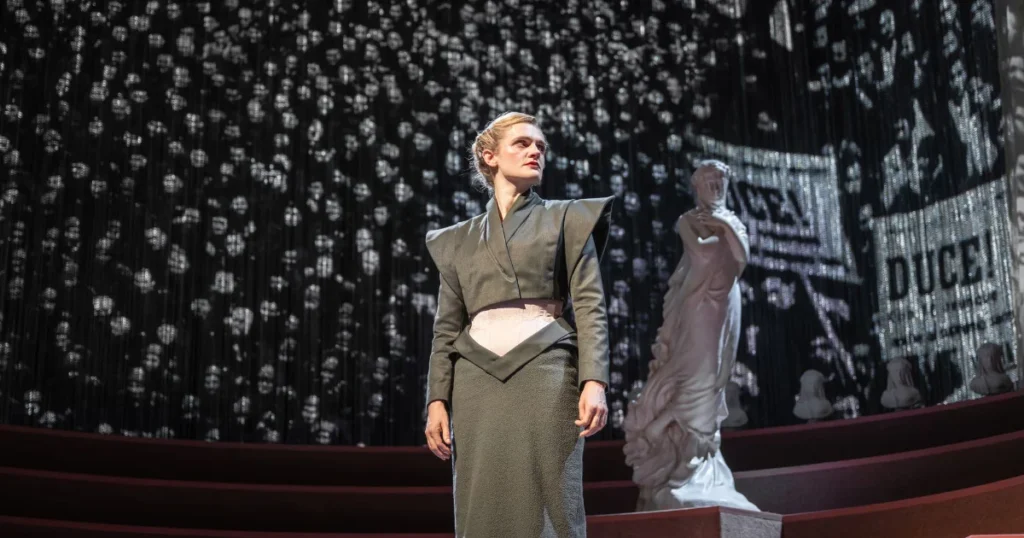
Thin curtains hang around the stage in Chloe Lamford’s sparse design. For most of the play, key phrases from Miss Brodie’s discourse and key works of art from her classroom are projected onto them. Towards the end, the curtains part to reveal a picture of thousands of faces in a crowd waiting in Italy for Il Duce himself. Yes, yes, the veil is parting and we can see the reality of fascism, though we never see its consequences. But the effect is to place Miss Brodie as one of the crowd. Understandable. Capable of being explained within the context of her time.
Spark’s Brodie, though, was a moral tragedy, one exemplar of the millions of moral tragedies of those who fell for the glamour and the false promises of the far right.
These days, the National Theatre of Scotland believes its vocation is to tell Scotland’s stories rather than to tell the best stories of the world in Scotland. To tell Miss Brodie’s story as though her choices were an explanation of the political sympathies of so many Scots of her time raises troubling questions of right and wrong. Stripping the central act of betrayal by her pupil of both its religious and political motivation feels ultimately unsatisfying.
This production is well acted and raises questions about how far-right politics get a foothold in a society. However, it wants to see Miss Brodie as a misunderstood woman of her time, rather than as Muriel Spark conceived her: a savage soul intent on replicating herself.
The National Theatre of Scotland kindly provided a ticket.
Photo credits: NTS|Mihaela Bodlovic