
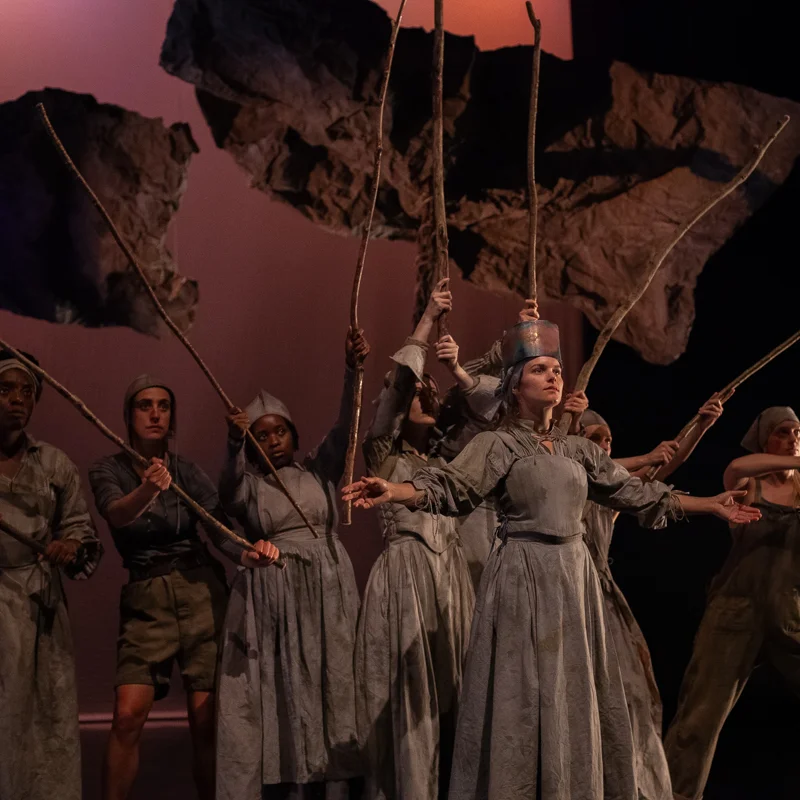
Macbeth is dead but the witches remain. What carries on when the normal rituals of daily life have been wiped out by a tyrant? Stones. Staves. The ability to move together, speak together and sway together. Out of the ruins of war, new rituals will arise.
Al Seed’s new production Thrice uses spellbinding visuals, rhythmic movement and choral speaking to enter a post-war world which defies easy classification. This isn’t a conventional play. Nor is it contemporary dance. It isn’t merely poetry and it isn’t delivered in prose. The piece owes a debt to them all but won’t be contained by any one of them.
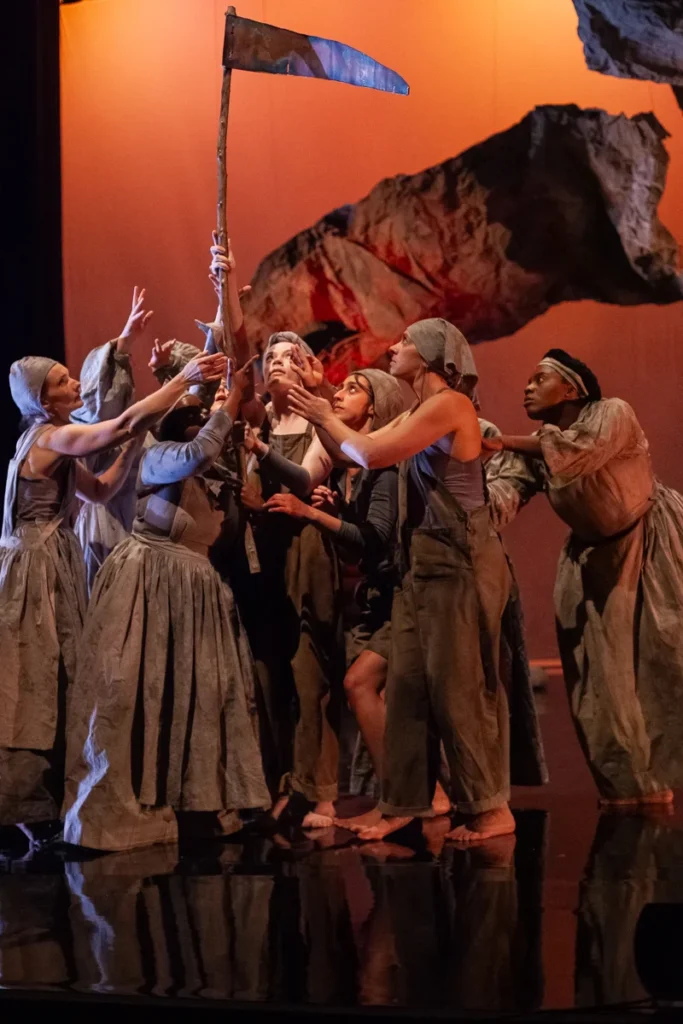
The vast stage of the Tramway is dominated by two gnarled wooden objects hanging in the air. Willow withies protrude from one and link the other to a round broken structure – a well, perhaps, which the witches will rebuild with some scattered stones for reasons that never become apparent. The floor is a polished black reflecting first the haze swirling about the stage and then doubling every movement of the witches who soon appear. A trio of witches, multiplied by three. Three witches thrice – nine women on stage.
There is something defiantly brave about refusing the conventions of storytelling. The witches move about the stage sometimes in their trio formations and sometimes as a larger group. They sway, they bend, they dance. Eyes stare, faces show despair and confusion. Yet ritual must be done. No final meaning ever seems to be found yet still there is a yearning to produce, to act together, to recall. Shapes are made on the stage, and patterns form in the mind of the audience as words and phrases from the Shakespeare play are heard both as part of the soundscape accompanying the piece as well as performed by the ensemble. All the words here come from the original play but are now broken away from their original context. Sometimes chanted and often repeated, they create the moods on the stage. Meanwhile a bold lighting design from Alberto Santos Bellido plays with moving shape and static silhouettes.
The stage itself is captivating but particular scenes also linger long in the mind despite being merely fragments.
In one of the most arresting scenes, one of the women is crowned with a golden ring that is later unravelled and mounted on one of the staves like a captured flag. Whilst wearing the crown, she is the monarch of the stage. She is carried in procession by attendants carrying staves, only for the stave bearers to surround her and criss-cross their staves in what is clearly a ritual beheading. The crown is carefully lifted from the head and ends up lying once again on the ground. By their ritual, the witches seem to convey that tyrants must fall. Does their movement demand that we must all play our part in their downfall?
However, that is to impute meaning into a performance that resists conventional narratives. The witches may mean that. They may not. They may not even know what their rituals will create if performed in the ruins of civilisation.
Alys Williams, Ashley Smith, Jennifer Steele, Jessie Roberts-Smith, Maya Bodiley, Monet Debois, Samuela Noumtchuet, Sarah Farrell and Tess Letham each bring a determined rigour to their collective spells.
In a disturbing post-war world, meaning seems a distant reality. Samuel Beckett’s ghost haunts the spaces that the witches inhabit. The sparse sensibility of the women in Jacqueline Harpman’s novel I Who Have Never Known Men also seems curiously near. In that work too, women move and act together in a world where explanations and resolutions never come.
People will try to find meaning even when all meaning seems over the horizon. The running time of just 50 minutes has both intensity and spectacle. If you can accept a show that offers rhythm and images rather than plot, then this is worth seeing.
Having opened in Glasgow at the Tramway, the piece now tours to Aberdeen’s Anatomy Rooms, Dundee Rep and the Traverse in Edinburgh through the rest of October.
Photography – Alberto Santos Bellido
A ticket was kindly provided by the Al Seed Company.