Sir David McVicar makes no attempt to soften Turandot. His production turns the opera towards public political violence, and the result is macabre, compelling and at times horrific, a production for macabre times in which every detail on stage has been carefully judged. The singing is superb, and the original Alfano ending, completed after Puccini’s death, offers more breathing space than usual to reflect on whether love really does conquer everything.
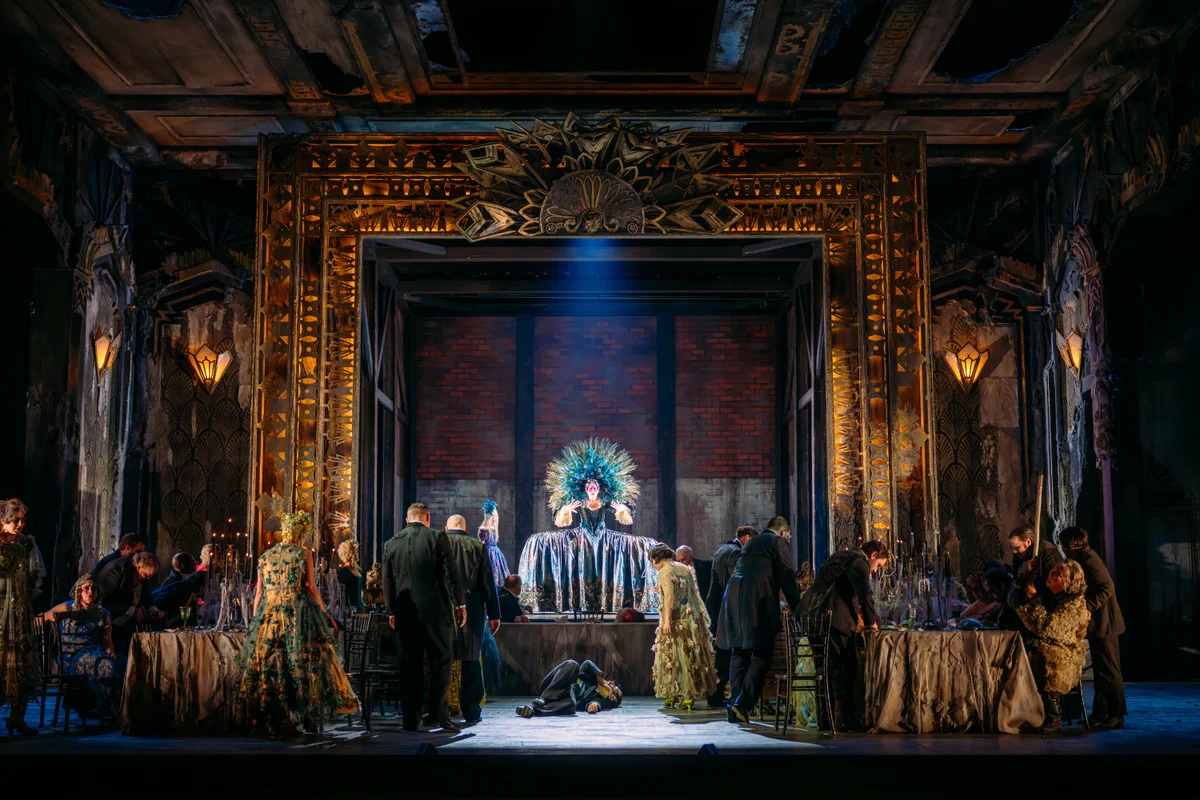
The political milieu in which the piece was composed is never forgotten. Mussolini was gaining power in the 1920s and fascism was on the rise. Charles Edward’s magnificent design takes us back to that period in gloomy art deco, with stages everywhere: a stage within a stage, a proscenium arch within a proscenium arch, and entrances from the wings through spaces controlled by large theatrical curtains. Central to so much of the action is the chorus of faded flapper girls and distressed gents who make up the populace of this world. They look as though they’ve been knocked about a bit, visibly bruised and damaged by living. Everything about them speaks of the emotional scars of keeping a totalitarian regime alive. Opera choruses are usually encouraged to show emotion by more than their singing. Here faces are kept utterly blank while the most glorious music is sung. It is unsettling, eerie and wonderfully strange.
There is ritual humiliation early on, as a failed suitor for Princess Turandot is led away naked to his doom. The chorus becomes her regime’s audience, its congregation and its accomplices. They inhabit a world where public cruelty is entertainment. The state appears powerful, but its grandeur is a façade, its ceremonies continuing long after their purpose has become monstrous and its inhabitants seemingly incapable of imagining life outside them. The palace is less a seat of government than a theatre of death in which everyone is condemned to play their assigned part. Kindness is absent.
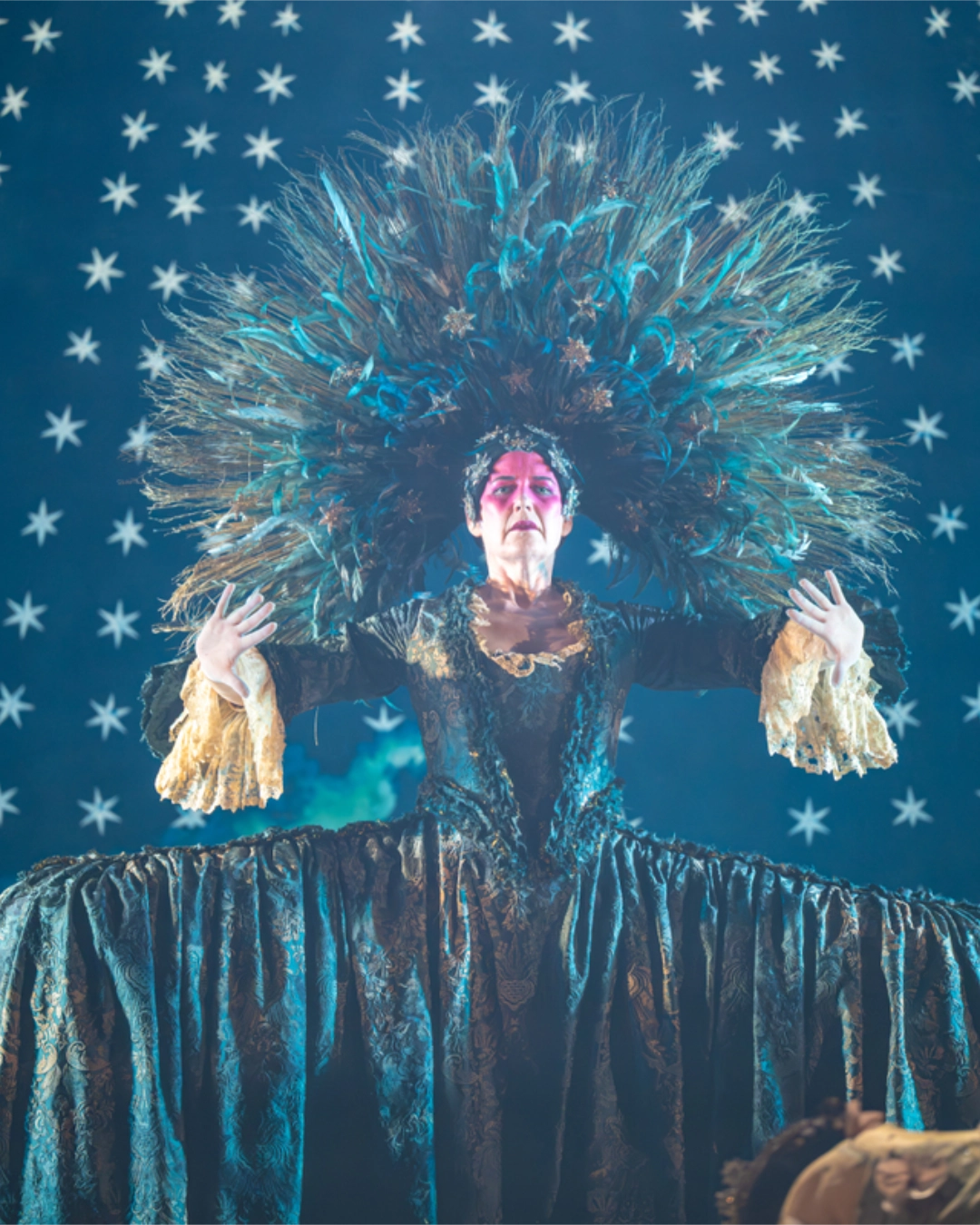
What is not absent, however, is exceptional singing. Trine Møller’s Turandot is emotionally icy but dazzlingly precise, her voice soaring over the wall of sound produced by orchestra and chorus. Victor Starsky, brings power and commitment to Calaf, with a stirring Nessun dorma. Hye-Youn Lee makes Liù’s tenderness and self-sacrifice deeply affecting, and her death is devastating in a world where compassion is one of the few forces the regime cannot entirely absorb. Calif’s father, Timur, is sung with dignified eloquence by Insung Sim.
Ping, Pong and Pang, though ministers of the Imperial Household, appear as vaudevillian characters and provide the comic business. Josef Jeongmeen Ahn, Aled Hall and Luvo Maranti sing them, and choreographer Gareth Mole gives them entertaining things to do.
In the pit, Stuart Stratford conducts an orchestra that rises to everything Puccini asks of it.
The decision to use Alfano’s original, extended completion gives the final confrontation a little more room than the familiar shortened ending allows. The real question is whether this makes Turandot’s transformation more credible. The space to think is welcome, but much still feels unresolved by the end.
McVicar leaves us with more riddles than Calaf manages to solve in his pursuit of the haughty princess. Does love conquer everything, or is it merely a tool that enables a strong young man to acquire power? And though the music seems to suggest that love can make all things new, what happens to a society that has grown accustomed not only to living under totalitarianism but to feeding and enabling it?
In the end, the regime isn’t dismantled. It simply moves on. A population trained to celebrate violence seems not to be on any kind of journey towards a more humane existence just because its rulers change. The boy gets the girl and the princess gets her suitor, but the strong suspicion is that the crowd will continue to cry out for, and be given, the violence on which it has come to depend.
As this production was being rehearsed, America was flirting with bringing back public executions. Though many riddles are solved along the way, this is a piece that allows us to examine the riddles of our own times. There is little comfort to be found.
Scottish Opera kindly provided two tickets to enable this review.
Picture credits – Mihaela Bodlovic